icon4

Free Delivery On Orders Over £20

NV products are only for people over the age of 18 years who either smoke or vape
Basket: 0 items

How to Choose the Right PES Membrane?

Choosing a Pes Membrane is not a matter of picking the smallest pore or the highest advertised flux. The right choice depends on the liquid, target particles, operating pressure, temperature, and cleaning routine. A membrane handling clear process water may behave very differently with a protein-rich feed. Look beyond the product label. Ask what the feed contains, how performance will be measured, and what happens after repeated cleaning.

A practical selection principle for this guide is: “Match the membrane to the feed, not just the specification sheet.” This is an editorial summary, not a verified quotation from a named expert. Professor Takeshi Matsuura is a recognized membrane researcher, but no source was provided to confirm a direct quote from him on PES membrane selection. That distinction matters. Reliable choices need evidence, not borrowed authority.

This guide will compare pore ratings, permeability, chemical compatibility, mechanical strength, and fouling behavior. It will also explain how module design and operating conditions affect real-world performance. A datasheet can narrow the options. Bench testing can expose a mismatch: flux may fall, cleaning may take longer, or product quality may drift. No membrane is perfect. The goal is a defensible fit for the application, supported by test data and supplier documentation.
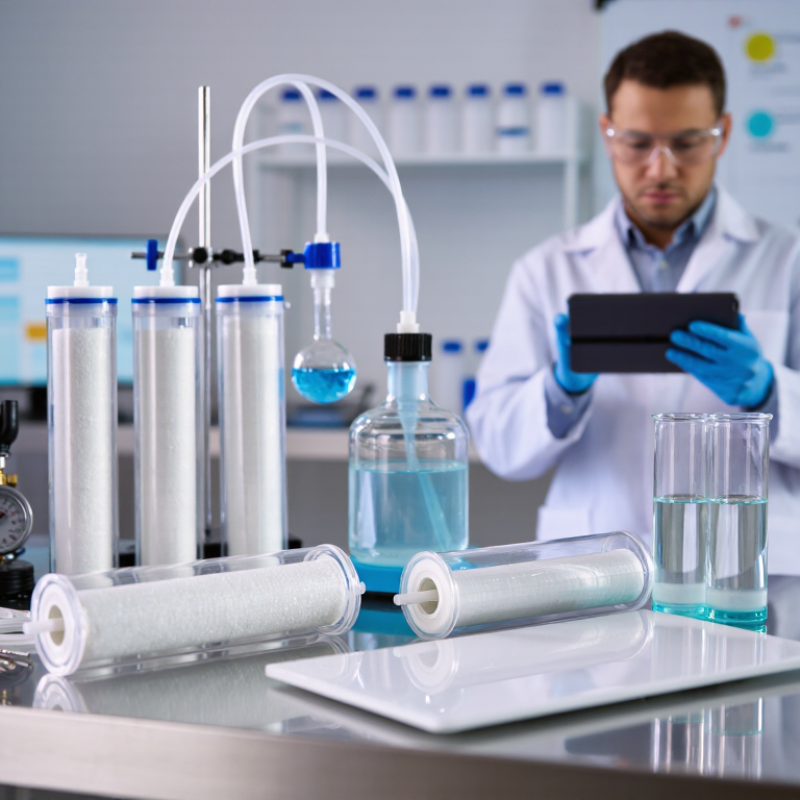
How to Choose the Right PES Membrane?

Define the Separation Goal: Choose PES Pore Ratings Such as 0.1, 0.2, or 0.45 μm

Choose the pore rating by defining what must stay in the process and what may pass through. A 0.45 μm PES membrane is often used to clarify liquids by reducing larger particles; it may not retain finer microorganisms. A 0.2 μm rating is common when tighter microbial retention is needed, while 0.1 μm provides finer filtration but can clog sooner. These ratings describe pore size, not a guarantee of performance. Actual retention depends on the membrane, fluid, and operating conditions.

For a useful benchmark, ASTM F838-20 describes bacterial-retention testing for membrane filters using Brevundimonas diminuta. Industry validation commonly applies a challenge of at least 10⁷ organisms per cm² of effective filter area. This is a test condition, not proof that every 0.2 μm filter performs identically. Check whether the supplier reports nominal or absolute ratings, and review test data for your specific liquid. I still treat pore size as a starting point, not a promise.

Tips: Filter a representative sample before scaling up. Record flow rate, pressure, and volume processed; a 0.1 μm membrane that blocks quickly may be the wrong choice. Small trials help.

How to Choose the Right PES Membrane?

Define the separation goal, then compare the nominal pore ratings.

Smaller pores provide a finer nominal rating. A 0.1 μm membrane is suited to finer particle reduction, 0.2 μm is commonly selected for sterilizing-grade filtration of compatible liquids, and 0.45 μm is often used for clarification or prefiltration. Performance depends on the membrane and process; pore rating alone does not guarantee retention. Confirm suitability with validated, product-specific data.

*Use a 0.2 μm rating for sterilizing-grade filtration only when validated for the specific application.

Match PES Membrane Format and Effective Area to Required Process Throughput

How to Choose the Right PES Membrane?

Match PES Membrane Format and Effective Area to Required Process Throughput

Start with the volume you need to process and the available operating time. A membrane’s effective area influences how much liquid can pass through it, but area alone does not determine throughput. Feed viscosity, particle load, temperature, and pressure also affect flow. A clean-water rating may not reflect performance with your actual product. That difference matters.

Choose a format that fits your system and process stage. Small discs can support screening tests, while capsules or cartridges may suit pilot and production equipment. For example, a pilot run with a 10-liter batch can reveal whether flow declines as the membrane loads. If the required area seems uncertain, test representative feed under realistic conditions. My estimate might still be off; operating data should guide the final choice.

Tips: Compare throughput at the same pressure and with the same feed. Track processing time, pressure change, and retained volume during trials. Allow margin for fouling and routine variation, rather than sizing to a best-case result. Check housing capacity and connection compatibility, too. A larger membrane area can help, but only if the format fits the system and the process can use it.

Compare Flux and Pressure Using the Same Test Conditions and Units

When choosing a PES membrane, published flux numbers can look decisive. But a high value means little unless test conditions match. Compare flux at the same temperature, feed composition, membrane area, and operating mode. Record transmembrane pressure (TMP), not just pump pressure; pressure losses across tubing can distort comparisons. Use one flux unit, such as L/m²·h, and state TMP in kPa or bar.

A practical comparison uses the same feed batch and sampling period. Keep pretreatment, crossflow or dead-end setup, and membrane conditioning consistent. If one sheet reports flux at 20°C and another at 25°C, don’t rank them directly; viscosity changes affect flow. Compare permeability only when calculated with a consistent formula and units, such as flux per unit TMP. Even then, fouling history matters. A quick bench test may not predict long runs. That’s easy to overlook.

Tips: Write conditions beside every result: temperature, feed, area, TMP, duration, and units. Repeat measurements, and note any cleaning or wetting step. If methods differ, label the comparison provisional. Small details count.

Verify Chemical and Thermal Compatibility, Including Any 121°C Steam Cycle

A PES membrane may look suitable on a specification sheet, yet compatibility depends on the exact grade and operating conditions. Check the manufacturer’s data for the membrane, support layers, seals, and housing—not just the polymer name. Chemical exposure changes with concentration, pH, temperature, and contact time. A cleaning solution that is harmless at room temperature may behave differently when heated.

Treat a 121°C steam cycle as a specific test, not a general assumption. Confirm the permitted exposure time, pressure, cycle count, and cooling conditions for the complete assembly. Repeated cycles can affect strength or flow even when one cycle causes no visible damage. Small changes matter. If possible, test representative filters after the planned sterilization cycles, then compare flow rate, integrity, and appearance with unused units. A clear membrane is not necessarily an intact membrane.

Review the full process history, too: cleaning agents, product contact, rinsing, and storage can all shape performance. Keep a compatibility record with actual concentrations and temperatures. I would be cautious about relying on a broad “steam compatible” claim alone; it leaves too much unsaid. If your use conditions differ from published data, ask for written confirmation or run a controlled evaluation before routine use.

Confirm 0.2 μm Sterilizing-Grade Claims with Validated Retention Tests

How to Choose the Right PES Membrane?

Confirm 0.2 μm Sterilizing-Grade Claims with Validated Retention Tests

A 0.2 μm rating is a starting point, not proof of sterilizing performance. Ask for bacterial retention data generated under defined, reproducible conditions. ASTM F838 describes challenge testing with Brevundimonas diminuta, a small bacterium used to evaluate sterilizing-grade liquid filters. Industry protocols commonly target at least 10⁷ organisms per square centimeter of effective filter area. Check the test fluid, pressure, temperature, membrane area, and recovery method. Details matter. A result from one setup may not transfer to yours.

Review the validation package, not just a product sheet. FDA’s Sterile Drug Products Produced by Aseptic Processing guidance calls for validating sterilizing filter performance, including bacterial retention and integrity testing. Confirm that the membrane’s integrity-test limits correlate with retention results, and that the test can be performed before and after use. Then assess compatibility with your actual process fluid, including exposure time and operating pressure. A clean-water result may not predict performance with a viscous or chemically challenging solution.

Look closely. Ask for the full protocol, acceptance criteria, and recovery controls. A label alone can feel reassuring, but it is not evidence. And test reports can still leave questions: I would want to know whether the challenge reflects routine worst-case conditions, not only an ideal laboratory run.

Article Source:

X
0
    0
    Your Basket
    Your basket is emptyReturn to Shop